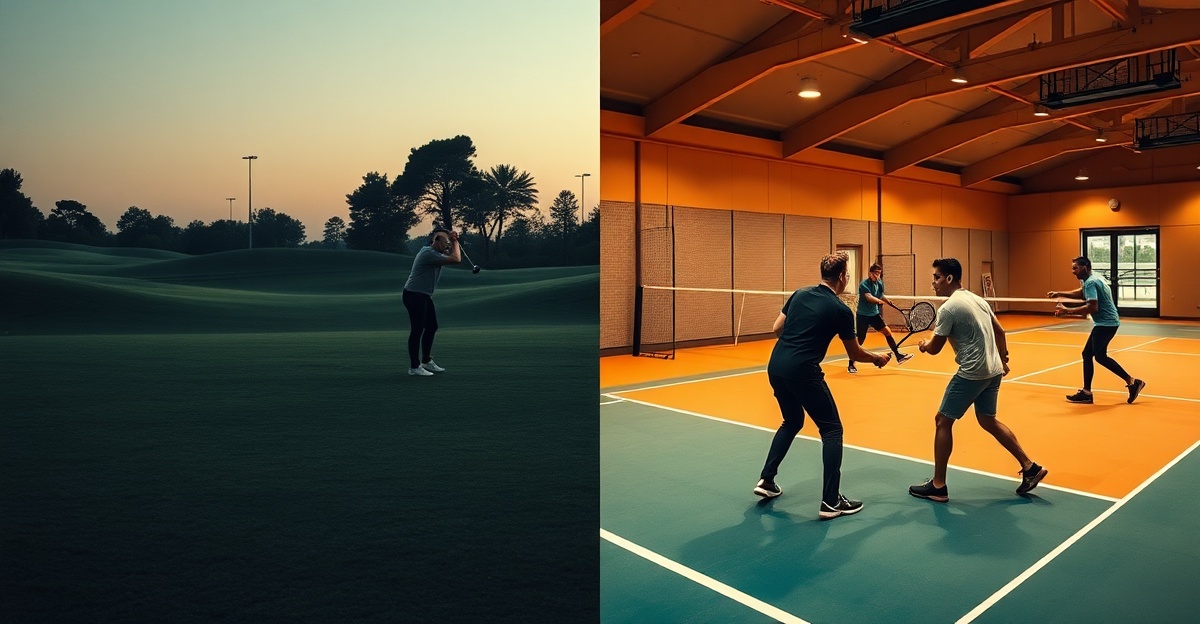
Padel Is the New Golf: Why Professionals Are Switching
Golf had a good run.
For decades, the 18-hole round was the unofficial boardroom extension. Deals got done on the fairway. Relationships were built over four hours, a shared buggy, and a pint in the clubhouse afterwards. If you were serious about business, you played golf. That was just how it worked.
That’s no longer true.
Something has shifted over the past two years. The professionals who are serious about building their networks (founders, sales directors, consultants, VCs) are quietly stepping off the course and stepping onto padel courts. Not as a hobby. As a deliberate networking strategy. And when you look at the numbers, the structure of the sport, and the quality of connections it produces, the reason is obvious.
Padel isn’t just a faster alternative to golf. It’s a structurally better networking tool.
TL;DR: Padel is replacing golf as the professional networking sport. A session takes 90 minutes, costs a fraction of a round of golf, and the Americano format means you have real conversations with 8-12 people instead of three. The one thing that kills the value is poor follow-up, which is why connecting on LinkedIn before you leave the court matters.
The LTA confirmed 860,000 UK players by end of 2025, more than double the 400,000 recorded in 2024, up from just 15,000 in 2019. Search interest grew 165% year-on-year. There are now 1,553 courts across 559 venues nationwide. This isn’t a trend. It’s a structural shift in how professionals spend their time and build their networks.
Golf Has a Time Problem
Let’s be honest about what a round of golf actually costs you.
Four to five hours on the course. An hour getting there and back. Another hour in the clubhouse. You’re looking at a full working day, minimum, for a single networking interaction with three other people. That’s before you factor in the green fees, the club membership, the equipment, and the fact that you need to be reasonably good at golf to avoid making the whole thing awkward.
Property+Padel put it well: “Who has time for 18 holes of golf anymore?”
The answer, increasingly, is: not many professionals under 45.
Golf also has an accessibility problem that the industry has been slow to acknowledge. It’s expensive to get into, takes years to play at a level where you’re not holding everyone up, and the demographic skew is significant. If your network doesn’t look like a 1990s golf club membership, golf isn’t a great equaliser.
None of this means golf is dead. It means golf’s monopoly on professional networking is over.
Why Padel Works Better as a Networking Sport
Padel solves every structural problem golf has, and it does it without sacrificing the thing that made golf valuable in the first place: shared physical experience as a trust accelerant.
The format forces interaction
A padel court is 20 metres long and enclosed by glass walls. You are physically close to your playing partners for the entire match. There’s no driving off in a buggy, no waiting on the tee box, no wandering down a fairway alone. The court creates constant, natural conversation.
You can pick up a padel racket for the first time and be genuinely competitive within a session or two. The learning curve is forgiving. That matters enormously for networking, because nobody is going to invite a client to an activity where there’s a real risk of embarrassment.
The time commitment is realistic
A padel session runs 90 minutes. You book it on a Tuesday lunchtime or a Thursday evening. You don’t need to clear your diary. At £27 per court per hour for a doubles booking (based on LTA pricing data), the cost per person is a fraction of a round of golf.
That lower barrier means you can run padel networking events monthly, or even weekly. Golf, realistically, is a quarterly activity at best for most professionals.
The numbers back the shift
-
860,000 UK adults played padel in 2025, up from 15,000 in 2019
-
57% of British adults are now aware of the sport
-
10 million Britons have expressed interest in trying it
-
165% year-on-year growth in UK search interest
-
The UK generates the highest gross monetary value per padel court globally (UHY UK)
That last stat is telling. British professionals aren’t just playing padel recreationally. They’re spending money on it in a way that no other country matches. The commercial intent is already there.
Padel vs Golf: The Honest Comparison
This isn’t about which sport is more enjoyable. It’s about which one is a better professional networking vehicle in 2026. Here’s the breakdown:
|
Factor |
Golf |
Padel |
|---|---|---|
|
Time per session |
4-6 hours |
90 minutes |
|
Cost per person |
£50-£150+ (green fees, membership, equipment) |
~£7-£14 per session |
|
Learning curve |
Years to play at a social standard |
Competitive within 1-2 sessions |
|
People met per event |
3 (your playing group) |
6-12+ (Americano format rotates partners) |
|
Conversation quality |
Intermittent, spread across 4+ hours |
Constant, high-intensity, enclosed court |
|
Repeat event frequency |
Quarterly (realistic for most) |
Weekly or monthly |
|
Accessibility for non-players |
Low: skill gap creates awkwardness |
High: beginners welcome and competitive |
|
Demographic reach |
Skews older, male, established |
Broad: 25-50, mixed gender, growing fast |
|
Networking ROI |
3 contacts per 6-hour investment |
8-12 contacts per 90-minute session |
|
Post-event follow-up |
Business card, email, hope for the best |
LinkedIn connection on court, instant |
|
Corporate event suitability |
Complex logistics, weather-dependent |
Indoor, bookable, scalable |
The networking ROI column is where the argument is settled. Golf gives you three people over six hours. An Americano-format padel event rotates you through every player on the court, meaning genuine one-on-one time with eight to twelve people in a session half the length.
That’s not a marginal improvement. It’s a different category of networking tool.
The Americano Format Is the Networking Engine
If you’re not familiar with the Americano, it’s the format that makes padel so effective for professional events. Rather than playing with the same partner throughout, partners rotate after every game. Everyone plays with and against everyone else over the course of the session.
The result is that by the end of a 90-minute Americano, you’ve had genuine competitive interaction with every person on the court. Not a handshake at the start. Not a brief chat at the bar. Actual shared experience, repeated, under mild pressure, with each person in the room.
That’s the psychological mechanism behind why padel networking works. Shared physical challenge accelerates trust faster than any meeting room interaction. You learn a lot about someone in 15 minutes of padel: how they handle pressure, whether they communicate, how they respond to a mistake. It’s not a recruitment process, but the signals are real.
“The Americano creates an environment where everyone is equal on court, regardless of title or seniority. That’s rare in professional settings — and it’s exactly why the connections feel different afterwards.”
For a full breakdown of how the format works and how to structure an event around it, see our guide to the padel Americano.
The Problem Nobody Talks About: What Happens After the Match
Here’s the part where padel networking still has a gap — and it’s worth being honest about it.
You play a great Americano. You’ve had real conversations with ten people. The energy is high. Everyone agrees to “stay in touch.” Then you walk off the court, get in your car, and by the time you’re home, you’ve lost three names and can’t remember which company the person in the green shirt worked for.
This is the exact failure mode that makes golf networking feel hollow too. The activity creates the connection. The follow-up process destroys it.
The professionals who are getting the most out of padel networking are the ones who treat the follow-up as part of the event, not an afterthought. That means:
-
Connect on LinkedIn before you leave the venue. Not the next day. On court, or immediately after, while names and faces are still fresh.
-
Reference the match specifically. “Great Americano session this morning — your backhand lob in game three was something else” lands better than any generic connection request.
-
Move the conversation forward within 48 hours. A coffee, a call, a specific reason to meet again. The connection decays fast if you don’t act on it.
Rallie was built specifically around this problem. Real-time scoring and leaderboards during the event, with one-tap LinkedIn connections so the follow-up happens on court rather than being left to memory and goodwill. If you’re running padel networking events, the connection infrastructure matters as much as the format.
The Transition Is Already Happening
The shift from golf to padel as the professional networking sport of choice isn’t a prediction. It’s already underway.
Corporate padel events are appearing on company calendars where golf days used to sit. Property firms, financial services companies, and tech businesses are booking courts for client entertainment. The LTA’s 2025 data shows the UK now has the highest gross monetary value per padel court globally — which means this isn’t casual recreational spend. It’s professional investment.
The 57% awareness figure matters here too. When more than half of British adults already know what padel is, the conversation has changed. You no longer need to explain the sport before inviting someone to play. That removes the last remaining friction from using padel as a networking tool.
The professionals who move early on this have a genuine advantage. The padel network in the UK is still relatively small and tight. The connections you make now, before the sport fully mainstreams, carry more weight than they will in three years when everyone is on court.
Golf had its moment. Padel is having its moment now, and unlike golf, it’s built for the way professionals actually work in 2026: time-poor, outcome-focused, and looking for quality interactions over performative ones.
If you want to start building your network through padel, the Rallie padel networking guide covers everything from finding events to running your own.
Frequently Asked Questions
Why is padel replacing golf for networking?
Padel is replacing golf because it is faster, cheaper, easier to learn, and better at creating repeated conversations. A 90-minute session gives professionals more touchpoints with more people, which makes it a stronger networking format for busy schedules.
What makes the Americano format better for business events?
The Americano rotates partners after every game, so players speak to everyone on court instead of staying with the same pair all session. That creates more shared experience, more natural conversation, and more chances to make useful professional connections.
Why do padel connections often disappear after the match?
Because the event ends and the details blur. People leave saying they will stay in touch, but without a quick LinkedIn connection or immediate follow-up, the connection fades fast. The match creates the bond, but the follow-up decides whether it lasts.
How can professionals grow their network through padel?
Use padel as the setting, not the whole strategy. Choose a social format like Americano, meet people who are open to networking, and connect on LinkedIn before leaving the venue. Then follow up within 48 hours with a specific reason to continue the conversation.
Is golf still better for senior business networking?
Golf still works in some circles, but it is slower, more expensive, and less accessible than padel. For time-poor professionals who want more introductions in less time, padel is the stronger option.