Padel Networking: The Complete Guide to Professional Connections on Court
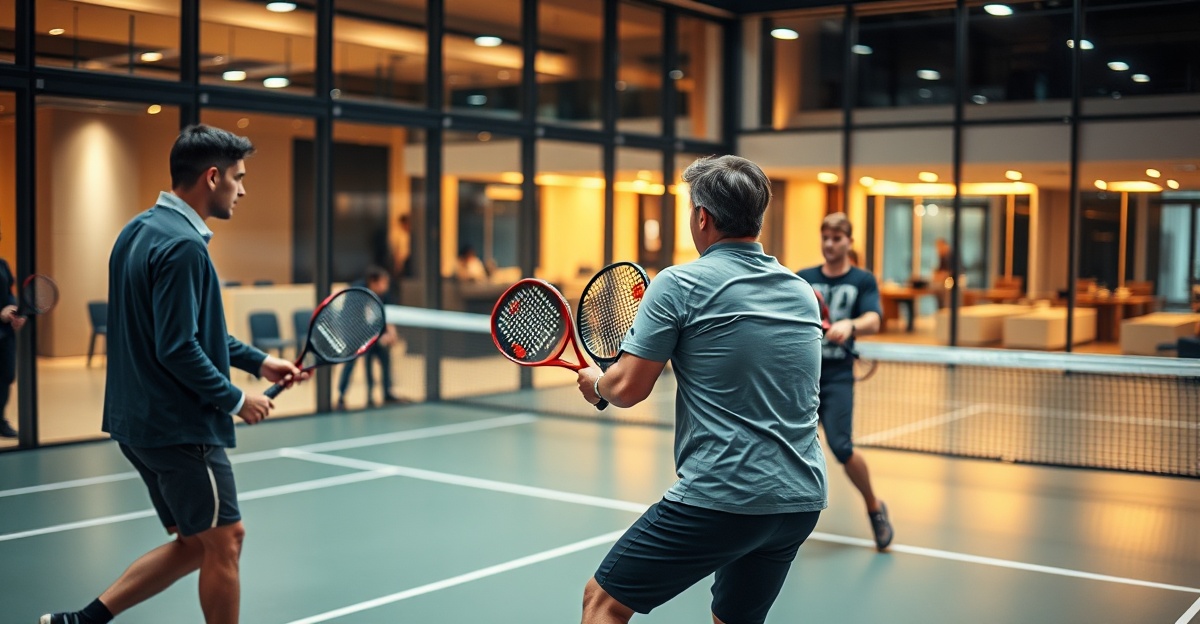
Padel networking is the practice of building professional relationships through structured padel play, typically in doubles or Americano-format matches where players rotate partners and opponents throughout a session. It combines sport with genuine social interaction in a way that traditional business events rarely achieve.
That definition matters now more than ever. According to the LTA, 860,000 adults and juniors played padel at least once in 2025, more than doubling the 400,000 who played in 2024. The court infrastructure has kept pace: 1,553 courts across 559 venues by the end of 2025, up from just 69 courts when the LTA took on governance of the sport in 2020.
The scale of the opportunity: 57% of British adults, roughly 31 million people, are now aware of padel, and over 10 million have expressed interest in trying it.
TL;DR: Padel beats golf for professional networking because it fits into 2 hours, rotates you through most of the room, and costs a fraction of a golf day. The Americano format is the engine. The LinkedIn follow-up is what makes it stick. This guide covers both, plus a full organiser playbook.
What’s in this guide:
-
Why padel outperforms golf as a networking format
-
How the Americano format creates natural relationship-building
-
What to expect at your first padel networking event
-
A step-by-step organiser playbook
-
Why networking breaks down after matches, and how to fix it
-
The LinkedIn follow-up flow that turns court conversations into lasting connections
-
Where to find padel networking events across the UK
Why Padel Beats Golf for Networking
The comparison keeps coming up because it keeps proving true. Golf has been the default corporate sport for decades, but it carries structural problems that limit its usefulness as a networking tool. Padel solves most of them. For a deeper look at why professionals are making the switch, read our analysis: padel is the new golf.
“Who has time for 18 holes of golf anymore? This marks the start of a new era in corporate sport. Padel is the new golf.” — Ben Nichols and Rohit Grewal, Property+Padel
The case is not just social. It is operational. UHY UK’s analysis of the UK padel market found revenue per court rose 74%, from €5.6k to €9.7k per month, a signal that clubs can sustain high-quality, repeatable events rather than relying on one-off occasions.
Padel vs Golf: A Direct Comparison
|
Factor |
Padel |
Golf |
|---|---|---|
|
Session length |
1-2 hours |
4-5 hours |
|
Players sharing the same space |
4 on one court, rotating |
2-4, spread across holes |
|
Barrier to entry |
Low, beginners are competitive within sessions |
High, years of practice needed to play confidently |
|
Conversations per session |
Multiple, with every rotation |
Limited, mostly with your playing partners |
|
Mid-week availability |
Evening sessions common |
Rarely practical before dark |
|
Cost per person |
~£7-£14 per hour |
£30-£100+ per round |
|
Venue accessibility |
559 venues across the UK |
Concentrated in suburban and rural areas |
What the Table Actually Means for Organisers
The format advantage compounds at scale. A padel networking event with 16 players across 4 courts generates dozens of distinct one-to-one interactions in under two hours. A golf day with the same headcount produces a fraction of that, spread across five hours and separated by long stretches of walking between shots.
For professionals with full diaries, the time argument alone is decisive. For organisers, the cost and venue accessibility arguments make padel events far easier to run consistently, monthly rather than annually, which is where real professional relationships actually form.
How the Americano Format Works for Networking Events
The Americano is the format that makes padel networking events work. Without it, you just have a padel session with business cards. With it, you have a structured social engine that puts every attendee on court with most of the room before the evening ends.
The Basic Mechanics
In a standard Americano:
-
Players are divided into groups and assigned to courts
-
Each match is short, typically 16-21 points or a fixed time such as 10-12 minutes
-
After each match, partners rotate so that players share a court with different people each round
-
Every player accumulates individual points across all their matches
-
A live leaderboard tracks standings throughout the event
-
At the end, the player with the most points wins, but the social outcome matters far more than the result
Why Americano Works Better Than Fixed-Format Play for Networking
-
More introductions per hour. A player in a 90-minute Americano session typically shares a court with 6-10 different people. Fixed doubles produces 3 at most.
-
Competition stays light. Individual scoring removes the pressure of letting a partner down, which keeps the atmosphere relaxed and conversation-friendly.
-
Natural conversation windows. The changeover between rotations is when the best networking happens. It is brief, informal, and structured by the format itself.
-
Mixed ability works. Because individual points accumulate regardless of partner quality, players of different standards can compete in the same event without frustration.
The Organiser’s Problem with Americano
Running an Americano manually is genuinely difficult. Scheduling rotations, tracking individual scores across multiple courts, and updating a live leaderboard by hand all create admin overhead that distracts from hosting the event well.
Rallie handles registration, Americano scheduling, live scoring, and leaderboards in one platform, so organisers can focus on the room rather than the spreadsheet.
What to Expect at Your First Padel Networking Event
First-time attendees often arrive expecting a business mixer with rackets. The reality is more relaxed, more physical, and more effective than that framing suggests.
Here is what a well-run padel networking event actually looks like:
-
Arrival and registration (15-20 minutes). Most events open with a drinks reception or coffee. This is your best window for introductions before the format takes over. Use it.
-
Format briefing (5-10 minutes). The host explains the Americano rules, court assignments, and scoring. You do not need prior padel experience to follow this.
-
Match rotations (60-90 minutes). Rounds are short and move quickly. You will play with and against most of the room. Conversation happens naturally between points and during changeovers.
-
Post-play drinks or food (30-45 minutes). This is where the conversations that started on court develop into something more substantive. The shared experience of playing together removes the awkwardness that plagues traditional networking events.
-
Leaderboard reveal and close. A good organiser ends the event with a moment of recognition, not a long speech.
What You Do Not Need to Worry About
-
Your ability level. Americano events are designed for mixed standards. Most organisers explicitly welcome beginners.
-
Bringing your own equipment. Most venues provide rackets and balls for hire or inclusion.
-
Hard selling. The best padel networking events have an unspoken rule: play first, talk business later. The on-court experience does the relationship-building work for you.
The goal at your first event is not to collect 20 contacts. It is to have 3-4 real conversations with people you would genuinely want to speak to again.
How to Organise a Professional Padel Networking Event
The demand is clearly there. The UK Padel Convention sold out with 750 attendees and over 45 exhibitors, demonstrating that professionals will show up when padel and business are combined with genuine intent. The question for organisers is how to build events that deliver on that promise repeatedly, not just once.
Step 1: Define Your Event Objective
Before booking a court, be clear about what you are building. The format and audience will differ significantly depending on your goal:
|
Objective |
Format recommendation |
Ideal size |
|---|---|---|
|
General professional networking |
Open Americano, mixed industries |
16-32 players |
|
Sector-specific networking |
Curated Americano, themed briefing |
12-24 players |
|
Client entertainment |
Private court hire, social Americano |
8-16 players |
|
Community or club building |
Regular monthly social |
16-40 players |
|
Sponsor activation |
Branded event with demo stations |
24-48 players |
Step 2: Choose the Right Venue and Court Count
Rotation quality depends on court count. As a rule:
-
2 courts: works for up to 16 players, but rotations are limited
-
4 courts: the sweet spot for most networking events, 16-32 players
-
6+ courts: suitable for larger corporate or industry events, requires more careful scheduling
Choose a venue with changing facilities, a social area for post-play drinks, and ideally a screen or display for the live leaderboard.
Step 3: Build a Clear Event Structure
A well-run padel networking event follows a simple script:
-
Registration and arrival drinks
-
Welcome and format briefing (keep it under 5 minutes)
-
Americano rotations with live scoring
-
Break with leaderboard update
-
Final rotations
-
Post-play drinks and leaderboard reveal
-
Close with a clear next-event date
Step 4: Handle Admin Through One System
The events that fail are almost always the ones where the organiser is juggling a WhatsApp group, a spreadsheet, and a handwritten scoreboard simultaneously. Registration, pairing, scoring, and post-event communications should run through a single platform.
Rallie was built specifically for this: registration, Americano scheduling, live scoring, leaderboards, and post-event LinkedIn connections in one place. If you are serious about running padel networking events at scale, manual admin is the first thing to remove.
Step 5: Plan the Follow-Up Before the Event Starts
The post-event follow-up is not an afterthought. It is part of the event design. Build in a moment at the close where you prompt attendees to connect on LinkedIn before they leave the venue. More on this in the next section.
Why Networking Breaks Down After Matches, and How to Fix It
This is the question nobody in padel networking is answering properly, and it is the reason most events produce fewer lasting connections than they should.
The Real Reasons Connections Die After Play
-
No memory trigger. You meet eight people across four rotations. By the time you leave the venue, you cannot reliably match names to faces, let alone recall what they do professionally.
-
No structured next step. Most events end with “great to meet you” and a vague intention to connect. Without a specific prompt, most people do nothing.
-
Context collapses quickly. The shared experience of playing together fades fast. A LinkedIn request sent three days after the event lands cold because the recipient no longer remembers the specifics of the conversation.
-
No roster or match history. Players cannot easily recall who they played with in which round, which makes personalised follow-up harder.
The Fix: Make Follow-Up Part of the Event
The most effective padel networking events treat the post-event connection as a designed moment, not an optional extra:
-
Prompt connections at the close. Before the final drinks, ask attendees to open LinkedIn and connect with two or three people they played with.
-
Provide a roster or match summary. A simple list of who played in each round removes the memory problem entirely.
-
Send a post-event email within 24 hours. Include the leaderboard, match results, and a nudge to connect with fellow players.
Rallie’s post-event LinkedIn connection feature is built around this exact problem: players can connect with everyone they played with directly from the platform, while the event context is still fresh.
The Post-Event LinkedIn Connection Flow That Actually Works
Converting court conversations into LinkedIn connections is straightforward when you follow a consistent process. The window is short: send your requests within 24 hours while the shared experience is still vivid for both parties.
The Three-Step Follow-Up Flow
Step 1: Connect the same evening or next morning
Send a personalised connection request, not the default “I’d like to connect.” Reference something specific: the court you shared, the round, or a moment from the match.
“Great playing with you at [event name] last night. That final rotation was close! Would love to stay in touch.”
Step 2: Follow up within 48 hours with context
Once connected, send a short message that bridges the court conversation to a professional context. Do not pitch. Reference what they do and why it is relevant to you.
“Enjoyed our chat between games. I work in [field] and what you mentioned about [topic] resonated. Happy to grab a coffee if useful.”
Step 3: Segment your follow-up by relationship type
|
Connection type |
Next action |
|---|---|
|
Peer or collaborator |
Share something relevant to their work within a week |
|
Potential client or partner |
Suggest a 20-minute call with a clear agenda |
|
Organiser or community builder |
Offer to help with the next event or share it with your network |
Why Specificity Wins
Generic follow-up fails because it gives the recipient nothing to respond to. The padel context is your advantage: you have a shared, memorable experience to reference. Use it. The more specific your message, the higher the response rate.
Where to Find Padel Networking Events in the UK
With 1,553 courts across 559 venues now operating across Great Britain, local discovery is getting easier. The cities with the most active padel networking scenes in 2026 are:
-
London: The largest and most established scene, with regular business-focused Americano socials, sector-specific events in tech and finance, and corporate court hire across central and east London venues.
-
Manchester: A strong and growing community with multiple venues running weekly socials and increasing interest from the city’s professional and startup communities.
-
Bristol: A tightly connected professional scene that suits the smaller, more curated networking format particularly well.
-
Birmingham: Growing rapidly, with new venues and an active padel community that is beginning to attract business-focused events.
-
Leeds: A strong base of regular players and a professional community that has embraced the sport quickly since court availability expanded.
-
Edinburgh: Scotland’s most active padel city, with a professional community increasingly using the sport as a networking vehicle alongside the broader Scottish business calendar.
To find events in your city, check club calendars directly, search community groups on LinkedIn, and look for Americano socials listed on venue websites. Rallie-powered events will be listed directly on the platform as the network grows.
Frequently Asked Questions
What is padel networking?
Padel networking is professional relationship-building through structured padel play, typically using an Americano format that rotates players across multiple matches so attendees meet most of the room in a single session.
Do I need to be a good padel player to attend a networking event?
No. Most padel networking events are designed for mixed ability levels. The Americano format means your individual score accumulates regardless of your partner’s level, so beginners can participate without holding anyone back.
What should I wear to a padel networking event?
Standard sports kit is fine: trainers or court shoes, shorts or leggings, and a breathable top. Most venues provide rackets and balls, but check when registering.
How long does a padel networking event typically last?
Most events run for 2 to 2.5 hours, including registration, match rotations, and post-play drinks. Some larger events extend to 3 hours.
How many people can attend a padel networking event?
A two-court event works well for up to 16 players. A four-court event suits 16-32 players. The format quality, specifically how many different people each attendee plays with, depends on keeping courts and player numbers balanced.
What is the best format for a professional padel networking event?
The Americano format is the most effective for networking because it rotates partners and opponents throughout the session, maximising the number of people each attendee interacts with.
When should I send LinkedIn connection requests after a padel event?
Send them the same evening or the following morning while the shared experience is still fresh. Include a brief, specific note referencing the event or a moment from your match.
What software do organisers use to run padel networking events?
Rallie is built specifically for professional padel networking events, covering registration, Americano scheduling, live scoring, leaderboards, and post-event LinkedIn connections in one platform.
How do I find padel networking events near me?
Check venue websites and club social calendars, search LinkedIn for padel networking groups in your city, and look for Americano social events in Manchester, London, Bristol, Birmingham, Leeds, and Edinburgh.
Can I host a padel networking event if I am not a club or venue?
Yes. Community organisers, professional networks, accelerators, and corporate teams all run padel networking events. You need a venue booking, a clear format, and a registration system. Rallie handles the operational layer so you can focus on curating the right room.
Start Building Your Padel Network
Padel creates the right conditions for professional connection. The format does the introductions. The rotations remove the awkwardness. The shared experience gives you something real to reference when you follow up.
What determines whether those connections become lasting professional relationships is the structure around the event: a clear format, a well-run session, and a deliberate follow-up process that starts before the final point is played.
Ready to run your own padel networking event? Rallie handles registration, Americano scheduling, live scoring, leaderboards, and post-event LinkedIn connections in one platform, so you can focus on building the room rather than managing the admin.
Written by Kobi Omenaka, Founder, Kobestarr Digital